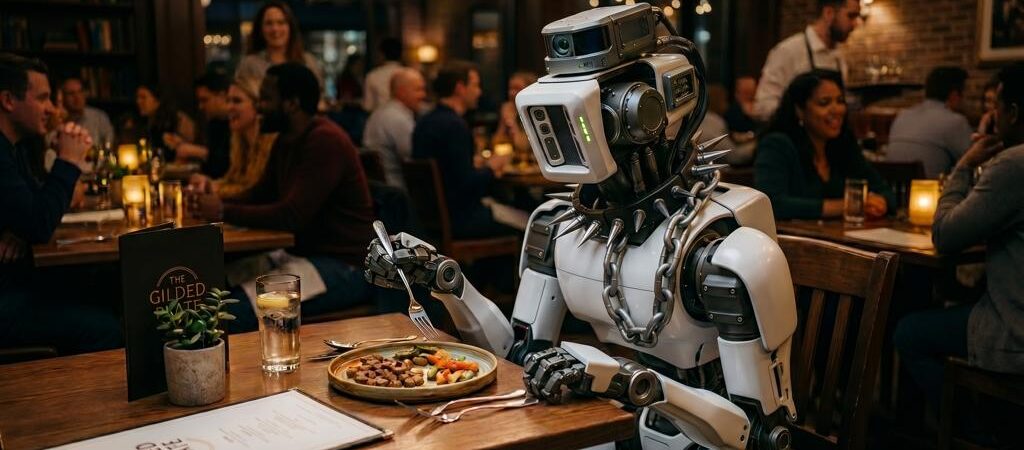
Not long ago, this question sounded provocative. Today, it sounds more like a statement of fact.
If we are being honest, in part of commercial photography the answer is already clear: yes, AI has taken a significant share of the market. And this is not about some distant future. It is happening now.
AI has not simply become another tool. It has started to replace entire categories of photography, especially where a client does not need a document of reality, but simply a striking image delivered quickly, cheaply and at scale.
There is, however, an important exception. And this is where the line is drawn between what AI can generate and what it still cannot genuinely replace. That exception is interior photography and 360 virtual tours, where a person is not buying an image alone, but trust in a real place.
Let us look at this in detail.
Where AI is already replacing photographers
1. Commercial product photography for routine advertising tasks
If a brand needs dozens of variations of a bottle, jar, cosmetic product or item of packaging placed in attractive settings, AI can now produce them in minutes.
There is no need to hire a studio, set up lighting, source props, book a retoucher, coordinate a team or pay for extensive post-production.
For many tasks, a real shoot has become economically difficult to justify. Why organise a production when an AI tool can generate an ideal image with no dust, no reflections, no damaged samples and no re-shoots?
This shift is particularly strong in niches where the client values:
- speed
- volume
- low cost per image
- endless variations for different formats and audiences
What used to require a photographer, assistant, retoucher and producer can now often be replaced by a marketer, a designer and a generative model.
2. Fashion photography for lookbooks, marketplaces and concept campaigns
Fashion photography once looked relatively protected: models, styling, lighting, mood, movement and atmosphere all seemed difficult to reproduce artificially. Yet this has become one of the areas where AI is most disruptive.
Today it is possible to:
- create a ‘model’ without an agency or fee
- change age, ethnicity, body type, pose and expression instantly
- visualise garments on virtual bodies
- swap locations without travel or production costs
- generate full campaign visuals without a real shooting team
For large brands, this means one thing: a sharp reduction in production costs.
For the market, it means something else: less demand for photographers, stylists, make-up artists, models, producers, studio hire and post-production specialists.
Yes, there is still room in the premium segment, in editorial work and in campaigns led by strong creative authorship. But the mass commercial market is already changing. Where the goal is not to produce a cultural statement but simply a constant flow of visual content, AI is faster, cheaper and easier to scale.
3. Stock photography
This is one of the most vulnerable genres of all.
Standard stock concepts such as “happy family in a kitchen”, “smiling doctor”, “office team in a meeting room” or “woman with a laptop in a café” can now be generated almost infinitely.
Why buy a stock image when you can generate one tailored to your exact need:
- with the right age of subjects
- in the right colour palette
- in the right interior
- in the right format for a banner or advert
- without the risk that a competitor is using the same image
Stock photography relied on standardised visual clichés. AI happens to reproduce those clichés extremely well.
4. Brand and concept imagery with no obligation to reflect reality
When a brand needs an idea, a mood, a symbol or a fantasy rather than a real scene, AI becomes an almost perfect supplier.
Surreal environments, impossible scenes, polished luxury aesthetics without luxury budgets — AI tools now produce these convincingly. What once required custom set builds, travel, location scouting and complex compositing can now be explored through prompts and iteration.
5. Social media content and endless A/B testing
Modern marketing runs on content overload. Brands need countless variations of visuals, covers, crops, creative tests, seasonal edits and campaign assets.
AI fits this logic perfectly. It does not get tired, does not need scheduling and does not increase the production budget in the way a human team does.
This is why AI is especially disruptive not to a handful of famous photographers, but to the many professionals who worked in high-volume commercial production: quickly, efficiently and at scale.
Why this has happened so quickly
Because the market does not buy talent in the abstract. It buys results measured by cost, speed and convenience.
If the client gets an image that does the job, they often care less whether it was captured with a camera or assembled by an algorithm.
Commerce does not make decisions according to the romantic logic of “art versus machine”. It makes them according to a much more practical question: what is faster, cheaper and easier to scale?
AI has not defeated photography as art.
It has defeated photography as a production service in areas where reality is no longer essential.
But there is one field where reality is not optional
That field is interior photography, hospitality photography, property photography, venue photography and 360 virtual tours.
Here, an image does not merely need to look appealing. It needs to correspond to the place itself — the restaurant someone will visit, the apartment they will book, the hotel they will stay in, or the venue they will hire.
When someone is choosing a restaurant, they want to understand:
- what the room actually looks like
- how much natural light there is
- how spacious it feels
- what the atmosphere is like
- how the tables are arranged
- what the windows look onto
- what they will see when they arrive
When someone is choosing an apartment or hotel, they do not want a beautiful fantasy. They want to see the real room, the real bathroom, the real layout, the real view and the real standard of the space.
This is where AI meets its main limitation:
it can create a convincing image, but it cannot guarantee the truth about a specific place.
Why AI cannot replace interior photographers
1. Because interior photography is not illustration — it is evidence
In advertising, you can sell an idea.
In hospitality, property and venue marketing, you have to sell confidence that expectation will match reality.
If a guest sees one thing and arrives to find another, the result is not delight but disappointment.
And disappointment in these sectors is expensive:
- poor reviews
- loss of trust
- cancelled bookings
- reputational damage
- the feeling that the customer has been misled
An AI-generated image may be more beautiful than reality. But that is precisely the problem. The more it “improves” a space, the greater the risk that it begins to misrepresent it.
2. Because a space cannot be honestly “invented”
Interior photography depends on proportions, pathways, ceiling height, room depth, the relationship between spaces, real lighting conditions and the logic of movement through a location.
This becomes even more important in 360 virtual tours, where the viewer is not just looking at one attractive angle, but actively orientating themselves within the environment.
AI can:
- add more flattering light
- make walls look cleaner
- make a room appear larger
- replace décor
- hide flaws
- invent details that do not exist
But once this happens, the image is no longer a truthful photograph of the property. It becomes a synthetic version of it, which may have only a loose connection to what is actually there.
For a restaurant, hotel, salon, clinic, showroom or apartment, that is risky. A customer does not step into a generated image. They step into a real place.
3. Because choosing a place means choosing an experience
People do not look at interior photography purely for aesthetics. They use it to imagine a future experience.
They are asking themselves:
- will I feel comfortable here?
- is this right for a date night?
- would I enjoy spending time in this space?
- is the room genuinely this bright?
- are the tables too close together?
- would this be suitable for work?
- does the space feel cared for or tired?
These are questions that only real photography of a real environment can answer properly.
Not an attractive approximation, but accurate visual information.
4. Because a 360 virtual tour creates transparency that is difficult to fake without consequences
A virtual tour is powerful precisely because it presents a space honestly and spatially.
It reduces uncertainty. A viewer can understand where they are going, how the rooms connect, what the proportions are and what details to expect.
AI can help with presentation, navigation, image clean-up, colour balancing, exposure correction, tripod removal and minor technical improvements.
But the foundation of a 360 virtual tour is still real capture of a real environment.
That is why virtual tours are not made obsolete by generative imagery. In fact, as people become more sceptical of images that look too perfect, the value of verifiable visual reality increases.
Where AI is genuinely useful in interior photography
It would be equally wrong to claim that AI has no place in this field. It already helps, and it will help even more.
AI is valuable where it speeds up work without replacing the factual basis of the image.
For example, it can:
- speed up image selection
- assist with basic retouching
- remove technical artefacts
- balance colour and light
- mask small defects in a shot
- automate routine post-production
- accelerate image preparation for websites, catalogues and listings
In other words, AI can be an excellent assistant.
But it is a poor substitute in any genre where the image must function as a document of trust.
For interior photography and 360 virtual tours, the right formula is not “AI instead of the photographer”, but “AI supporting the photographer”.
The wider social problem
The most troubling part of this shift is not only technological. It is social.
When AI replaces a photographer, the money saved does not usually remain within the creative economy. More often, it is redistributed upwards — towards platforms, technology owners, large corporations and those who control the infrastructure.
And it is not just photographers who are affected. Entire chains of human work are weakened:
- assistants
- retouchers
- stylists
- make-up artists
- models
- producers
- studio teams
- local services built around shoots
So AI does not simply remove one role. It can hollow out an entire ecosystem of work.
This raises a serious public question:
if more and more visual content is created without people, how will the people displaced by that process afford to participate in the economy that content is trying to influence?
This is no longer just a debate about tools. It is a debate about the redistribution of capital.
While some companies celebrate lower production costs, society absorbs the wider consequences:
- fewer opportunities for creative professionals
- fewer entry points for young people into the industry
- less work for local service economies
- greater concentration of income among those who own the models, compute and platforms
There is also an irony here. The entire image economy depends on the attention and spending power of ordinary people. But if those people lose work, security and income, then eventually the wider market is weakened too.
People without stable incomes travel less, book fewer apartments, go out less often and spend less on the kinds of services promoted through visual marketing.
In that sense, the problem returns to business itself.
Why real photography may become more valuable, not less
The more synthetic imagery fills the market, the more valuable genuinely trustworthy imagery becomes.
Real interior photography and 360 virtual tours are not just marketing materials. They are signals of transparency.
They tell a potential customer:
this is a real place, shown honestly.
That matters especially in sectors where decisions depend heavily on visual trust:
- restaurants and cafés
- hotels and apartments
- clinics and salons
- offices and co-working spaces
- event venues
- showrooms and commercial property
In these sectors, the winning image is not the most “perfect” one. It is the one that is most credible, informative and honest.