When people look at an interior or architectural photograph, they rarely analyse it point by point. They do not consciously say to themselves: the perspective is well controlled here, the verticals are straight here, the colour has been balanced properly here, and the light feels natural here. Yet these are exactly the details they register almost instantly and often subconsciously. And these are the details that shape the overall impression of the image: whether the space looks professional, whether it feels trustworthy, and whether it makes someone want to visit, stay, book, buy, or simply take it seriously.
That is why interior and architectural photography in London is not simply about photographing attractive buildings and interiors. It is about working with visual perception itself. This is especially true in a city like London, where the architectural landscape is extraordinarily varied: historic façades, Victorian interiors, contemporary offices, restaurants, boutiques, hotels, and new residential developments all exist side by side. In that context, the quality of photography becomes not a decorative extra, but a language of trust.
Why interior photography works on a subconscious level
When someone looks at an interior photograph, what they respond to first is not the furniture or finishes, but the sense of order. Does the space feel coherent, stable, logical, and natural? If the image is easy to read, the viewer tends to feel that they are looking at a high-quality place: a carefully designed interior, a professional environment, a space held to a high standard. If the image feels visually awkward or inconsistent, that impression weakens, even if the viewer cannot explain exactly why.
This is the paradox of professional interior photography: the most important qualities of a strong image are often the least obvious. Yet they are precisely what determine whether a photograph feels refined, convincing and valuable.
Correct geometry is the foundation of trust
One of the clearest signs of professional interior and architectural photography is correct geometry within the frame. That means vertical lines should remain vertical, walls should not appear to lean, door frames and windows should not distort, and the space should feel balanced and properly proportioned.
When geometry is wrong, viewers do not usually identify it as a technical problem. They simply perceive the image as less polished. The space may feel strange, unstable, or even somehow cheaper. This is particularly important in commercial photography: images of offices, restaurants, clinics, hotels, showrooms and residential interiors need to do more than show a room. They need to present it as a place that deserves confidence.
That is why perspective and straight verticals are so important in professional photography. When the lines are controlled properly, the image feels calm. It does not fight the viewer. It appears precise, composed and credible.
Why correct perspective evokes classical aesthetics
There is also a deeper cultural layer to this. Correct linear perspective is one of the fundamental principles of Western European art, developed during the Renaissance. This was the moment when pictorial space began to be built according to mathematical logic: depth, structure, alignment and architectural clarity.
For that reason, when perspective is controlled accurately in contemporary architectural photography, the image can evoke a subtle, often unconscious association with classical aesthetics. With museum-quality imagery. With a visual culture in which order, proportion and perspective are marks of refinement.
This is especially relevant in London. It is a city with a powerful architectural heritage, a strong cultural memory, and a highly developed visual standard. As a result, architectural photography in London is particularly sensitive to issues of geometry, precision and compositional discipline.
Tilt-shift lenses: why they matter in interior and architectural photography
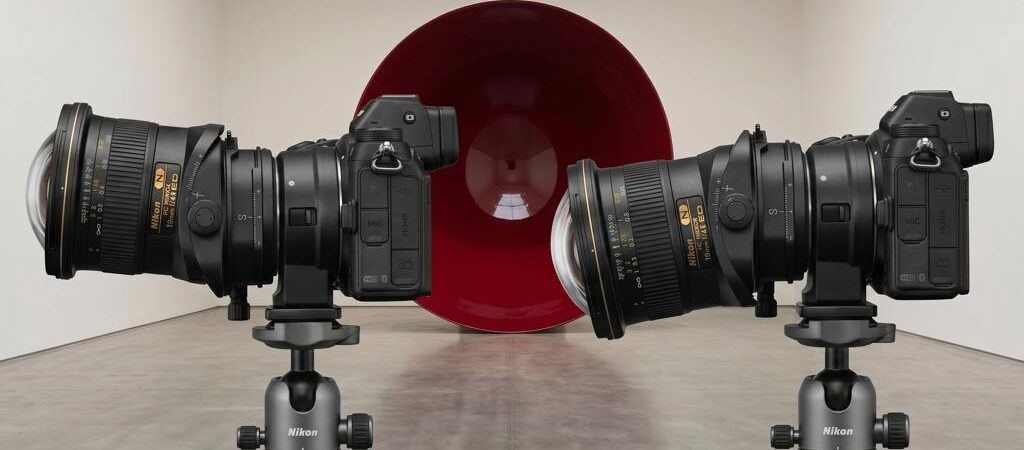
When discussing high-end interior and architectural photography, it is impossible to avoid the subject of tilt-shift lenses. These are the tools that make truly accurate geometry possible.
It is important to understand that tilt and shift are not the same thing.
Shift is used to control perspective. It allows the lens to move relative to the sensor without tilting the camera body. This makes it possible to keep vertical lines straight even when photographing tall walls, façades, windows, doorways or interiors with strong architectural structure. For interior and architectural photography, this is essential.
Tilt controls the plane of focus. It is used more selectively, but it allows the photographer to direct sharpness very precisely within the scene when the composition requires it.
Strictly speaking, it is shift that is most critical for architectural and interior photography. When a viewer looks at a photograph in which the verticals are straight and the space is not distorted by a wide-angle lens, they tend to perceive it as more professional, more refined and more trustworthy.
That is why interior and architectural photography in London at a genuinely high level is almost always associated with specialist optics and careful control of perspective.
Why you cannot simply “fix it later”
Many people assume that geometry can always be corrected in post-production. To a point, that is true. Modern software can straighten verticals, adjust perspective and remove some distortions. But software correction is always a compromise.
When perspective is corrected after the photograph has been taken, part of the frame is often lost, the composition changes, and some of the integrity of the original image may be reduced. Sometimes the image becomes technically straighter, but visually less natural. A professional approach is not about rescuing an image after a mistake has been made. It is about constructing it correctly from the outset.
In commercial photography, this matters even more. If an image is meant to support a brand, sales, reputation and positioning, then the geometry cannot be merely acceptable. It needs to be exact.
Colour in interior photography: the camera does not see as we do
Another essential component of trust in an image is colour. And here there is a crucial point: a camera does not see a space in the same way that a person does.
In a real interior, a viewer usually perceives colour in a balanced way. A white wall still feels white, timber looks natural, textiles retain their character, and the atmosphere of the room feels coherent. A camera, however, records light literally. If the frame contains warm artificial lighting, cool daylight from a window, decorative accent lighting and reflections from different surfaces, the image can easily break apart into separate colour zones: yellow in one area, blue in another, perhaps greenish elsewhere.
Such an image may be technically accurate, but psychologically it feels unconvincing. The viewer reads it as visually fragmented. The space begins to look untidy, even if in reality the interior is extremely well designed.
That is why professional colour grading in interior photography is not about embellishing reality. It is about bringing the image closer to human perception. A strong interior photograph shows the space not as the camera sensor records it mechanically, but as the eye and brain experience it.
Why natural colour increases trust
When colour is balanced properly in an interior image, the viewer does not notice the correction as an effect. They simply feel that the space looks natural. White surfaces do not drift into dirty yellow, daylight does not become harsh blue, materials retain their real character, and the whole image feels unified.
This is especially important for commercial spaces in London: restaurants, offices, boutiques, apartments, hotels, private clinics and salons. In all of these cases, the image needs not only to show the interior, but to convey the atmosphere of the place in a way that inspires confidence. If the colour falls apart, trust falls with it.
Light and tonal balance: why professional photography feels calm
One of the most common challenges in interior photography is the difference between the brightness of a window and the brightness of the room itself. The human eye adapts to this easily. A camera does not. Without careful exposure control, an interior will often end up either too dark or with windows completely blown out.
Professional interior and architectural photography relies on a subtle balance of light. In a well-made image, the interior retains its volume, texture and atmosphere, while the window does not become a blank white shape. This creates a sense of realism. The viewer feels that the space can be experienced, that it has depth, natural light and real materials.
By contrast, when an image is too contrasty, overexposed or muddy and flat, it starts to look technical, accidental and unfinished. For commercial use, that is critical: the image no longer supports the value of the property or the brand.
What most often gives away an unprofessional interior photograph
There are several signs by which an unprofessional image is recognised almost immediately:
- leaning verticals
- an excessively wide angle that stretches furniture and walls
- a clash of warm and cool light
- unnatural colour
- blown-out windows
- blocked shadows
- heavy-handed editing
- the sense that the room looks worse in the photograph than it does in reality
All of these errors work against trust. Even if the interior itself is excellent, the photography can make it feel less convincing.
What makes interior and architectural photography truly professional
Professional photography is not about making a space look “beautiful” at any cost. It is about respecting the space and respecting the way people see. A strong interior or architectural image:
- preserves correct geometry
- uses accurate perspective
- renders colour naturally
- removes visual noise
- creates a sense of cohesion
- strengthens the impression of order, quality and trust
That is why interior photography in London and architectural photography in London demand more than equipment alone. They require visual discipline. It is not enough to photograph a room brightly and widely. The image must operate at the level of perception: calmly, precisely and convincingly.