For restaurant owners, Google Maps is no longer just a listing. It is often the first place a customer sees your venue, compares you with nearby competitors and decides whether to book, call or keep scrolling. Google says local visibility is mainly shaped by relevance, distance and prominence, and it recommends that businesses keep their profiles complete, accurate and up to date. For restaurants specifically, Google highlights menus, bookings, reviews, and photos and videos of the interior, exterior and overall dining experience.
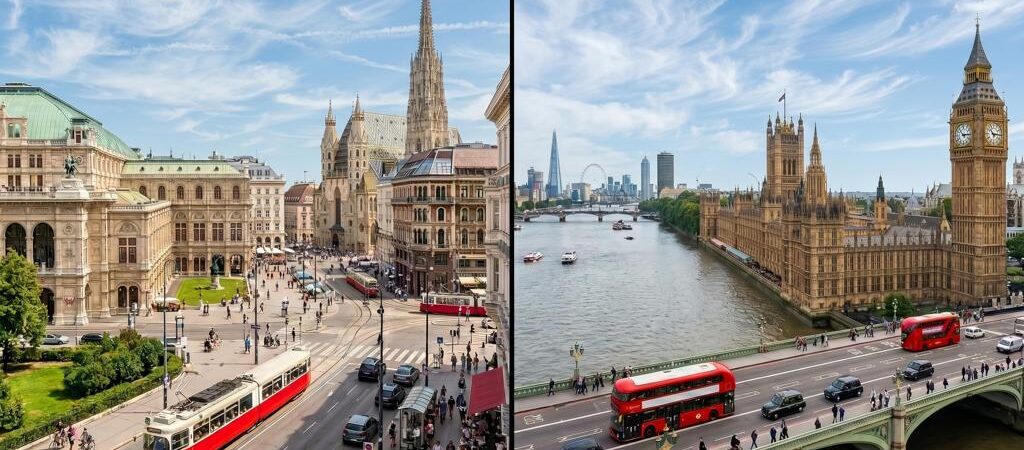
That basic framework is the same in Vienna and London. What changes is the way people choose. London’s tourism strategy puts food and drink, unique experiences, welcome and value for money at the centre of the visitor offer. Vienna, by contrast, frames its visitor economy around quality of life, quality of place and quality of experience. For restaurant owners, that difference matters: in London, your profile needs to help people choose quickly; in Vienna, it needs to make the venue feel trustworthy, well-placed and naturally part of its surroundings.
Why the same Google profile performs differently in each city
A restaurant does not compete in the abstract. It competes inside a local decision-making environment.
In London, diners often make fast choices in highly competitive areas, with multiple similar options within a short walk. London & Partners’ visitor experience work is especially revealing here: food and drink is one of the strongest drivers of destination choice, but it also scores comparatively weaker on value for money and uniqueness of offer. In other words, people care about where they eat in London, but they are also quick to question whether a venue is worth it.
Vienna presents a different challenge. The city’s strategy explicitly connects tourism to quality of life, quality of place and local neighbourhoods. Vienna’s official destination content also leans heavily on districts, local character, markets and atmosphere. That means a restaurant profile in Vienna has to do more than look attractive. It needs to feel believable and situated — like a real place in a real part of the city, not a generic stop for passing tourists.
For restaurant owners, this is the core strategic insight: Google Maps SEO is not only about filling in fields correctly. It is about matching your profile to the way customers make decisions in your city.
What restaurant owners should get right first
Before thinking about content, most venues need to tighten the fundamentals. Google is clear that complete and accurate business information helps a profile appear for relevant searches. It also recommends keeping hours updated, replying to reviews, and using photos and videos to show what the business actually offers.
Category choice matters more than many owners realise. Google advises businesses to choose the most specific primary category available, and notes that category-specific features are unlocked based on that choice. For restaurants, those features include links for online orders, reservations and menus, as well as the ability to add menu items directly. A weak category setup can therefore reduce both discoverability and conversion potential.
This is the baseline in both cities: accurate profile, correct primary category, working booking options, complete menu, current hours, strong review management and visuals that help customers understand the venue before they arrive.
London: your profile needs to reduce decision time
In London, your Google Business Profile should function almost like a landing page. It should help a potential guest answer a few questions immediately: What sort of place is this? What is the likely spend? Does it suit my occasion? Can I book quickly? Is it actually worth choosing over the restaurant next door?
That is why the menu matters so much. Google explicitly encourages restaurants to create detailed menus with sections, dishes, descriptions and prices, and identifies menu clicks and completed bookings as top performance metrics for restaurant profiles. In a market where users are often choosing quickly, a proper menu is not an admin task — it is part of conversion.
Visual clarity is equally important. Google recommends showing the interior, exterior and overall dining experience. In London, those assets should be chosen to reduce hesitation: entrance, seating layout, lighting, bar area, room size, terrace, atmosphere and social energy. If the space is one of the reasons people choose the restaurant, then the profile should make that visible at a glance.
This is exactly why restaurant virtual tour London, 360 virtual tour for restaurants in London and 360 photography for restaurants London are commercially useful. Google does not say that a 360 tour is a direct ranking factor, but it does say that visuals make a profile more complete and help customers understand the business. In London, where speed of choice matters, a 360 tour works best as a conversion tool: it helps diners understand the venue faster and makes it easier to feel confident about booking.
One more underused lever in London is Business Profile posts. Google says posts can share offers, updates and events, and that they help customers decide to visit. For restaurants, that is especially practical: pre-theatre menus, brunch launches, seasonal dishes, weekday offers and special events can all support decision-making at the exact moment a customer is comparing options.
Vienna: your profile needs to build trust in the venue
Vienna asks more of a restaurant profile emotionally, even if the technical setup is the same.
Because the city positions itself around quality, place and the lived experience of neighbourhoods, a restaurant profile in Vienna works best when it feels coherent and grounded. Diners need to understand not only what the food looks like, but what kind of place this is, how it sits within the district, and whether it feels authentic rather than purely transactional.
That is why exterior imagery can be especially powerful in Vienna. The frontage, terrace, courtyard, street view and entrance often do more than simply help recognition. They help convey the setting. Google itself recommends exterior and interior visuals so customers know what to expect. In Vienna, that expectation is closely tied to atmosphere and neighbourhood fit.
Review management also plays a slightly different role. Google recommends replying to customer reviews, and notes that helpful replies can help a business stand out. In Vienna, the tone of those replies often matters as much as the rating itself. Calm, thoughtful and service-oriented responses reinforce the impression of quality and reliability, which aligns well with how the city itself frames its visitor experience.
A 360 tour still has value here, but the role is slightly different. In London, it is primarily there to speed up the booking decision. In Vienna, it is often more powerful as a trust asset: a way to show that the venue genuinely has the atmosphere, layout and quality it claims to have.
The most useful comparison for restaurant owners
The most practical takeaway is this:
In London, your Google Maps profile should help people choose quickly.
In Vienna, it should help them trust the place.
That single distinction changes how you should think about content.
In London, prioritise speed of understanding. Make the offer obvious. Make the menu useful. Make bookings frictionless. Show the space in a way that supports fast comparison. Use posts to promote timely reasons to visit.
In Vienna, prioritise atmosphere and fit. Show where the restaurant sits in its setting. Keep visuals calm and coherent. Use reviews and replies to reinforce service quality. Make the profile feel polished, current and believable.
What a strong Google Maps profile should include now
A strong restaurant profile in either city should include a verified listing, the most specific primary category possible, accurate opening hours including special hours, a detailed menu, a working booking route, recent photography, active review replies and content that reflects the real experience of the venue. Google’s own guidance supports all of these elements.
Where many restaurants still miss an opportunity is in the presentation of the space itself. If your room, bar, terrace or layout helps sell the experience, then a professionally produced 360 tour is not just decorative content. It can strengthen the listing by making the venue easier to understand and easier to choose.
CTA Section
Want your restaurant to perform better on Google Maps?
If your venue sells through atmosphere as much as food, a strong visual profile can make a measurable difference. We create 360 virtual tours for restaurants in London that help potential guests understand your space faster, trust the venue sooner and move from browsing to booking with less hesitation.
Our service is ideal for:
Restaurants with distinctive interiors
Fine dining and premium casual venues
Bars and restaurants with terraces or rooftop spaces
New openings that need stronger visibility on Google Maps
Established venues looking to improve bookings from local search
Call to action:
Book a 360 tour consultation for your restaurant in London
SEO FAQ
Does a 360 virtual tour improve Google Maps rankings for restaurants?
Not as a direct ranking factor. Google does not say that a 360 tour by itself boosts rankings. What Google does say is that complete, accurate profiles with strong visual content help customers understand a business better, and complete information supports local visibility. In practice, a 360 tour is best treated as a conversion and profile-quality asset.
What matters most for restaurant SEO on Google Maps?
The fundamentals are accuracy, relevance and prominence: correct category, complete profile information, current opening hours, strong reviews, useful replies, menu content, booking options and visuals that reflect the real venue. Google’s restaurant guidance makes all of these areas important.
Why does local SEO strategy differ between London and Vienna?
Because customers choose differently in each city. London’s visitor strategy puts more emphasis on food and drink, value for money and quick, compelling experiences, while Vienna frames tourism more around quality of place, local districts and atmosphere. That changes how a restaurant should present itself in Google Maps.
Should restaurants post updates on their Google Business Profile?
Yes. Google says posts help customers decide to visit. For restaurants, they are especially useful for seasonal menus, special events, limited-time offers, brunch, set menus and other reasons to choose the venue now rather than later.
What kind of restaurant benefits most from a 360 virtual tour?
Restaurants where the physical space plays a major role in the buying decision tend to benefit most: premium interiors, romantic dining rooms, rooftop venues, stylish bars, courtyard restaurants and concept-led spaces where ambience is part of the product.